

Retreat Outline
Podobovets, Ukraine May 16th to 20th, 2026
Preamble
Metaphors build bridges to other perspectives. That includes not only how we look at life but also
how we experience it at physical and emotional level. Learning to use them enormously expands
the possibilities of clients who feel afflicted by unsurmountable difficulties. They are powerful tools
for working with injured soldiers who experience pain, with clients who lost perspective on life and
for those for whom there seems no way out.
As is often the case, the topic and approach of this retreat may sound abstract but carries direct
application for our work with clients. The structurally deeper we understand things the easier they
get.
Introduction: The Metaphoric vs The Syntactic vs The Semantic
CHANGING THE RELATEDNESS
Systemic Therapy does not address the substance of problems directly: Instead it assumes that
the way things relate to each other filters how we see the world and that we unconsciously fill the
form of our possible world under those filters with a semantic story.
We have practiced many ways to change relatedness. For example we have practiced introducing
changes to how we relate to the problem, changing safety, distance, angle and autonomy,
whether we phrase it as an action or as something that arises.
In this retreat we introduce a new class of variation in our relation to the problem by emphasizing
the image generating side in us.
IMAGE VS STRUCTURE THINKING
In communications theory we distinguish several layers in which we deal with the world:
semiotics, syntactical structure, semantics and practice.
In semantics we ascribe fixed characteristics, in syntactics we highlight the logical structure of
relatedness and in semiotics we focus on what a sign may stand for.
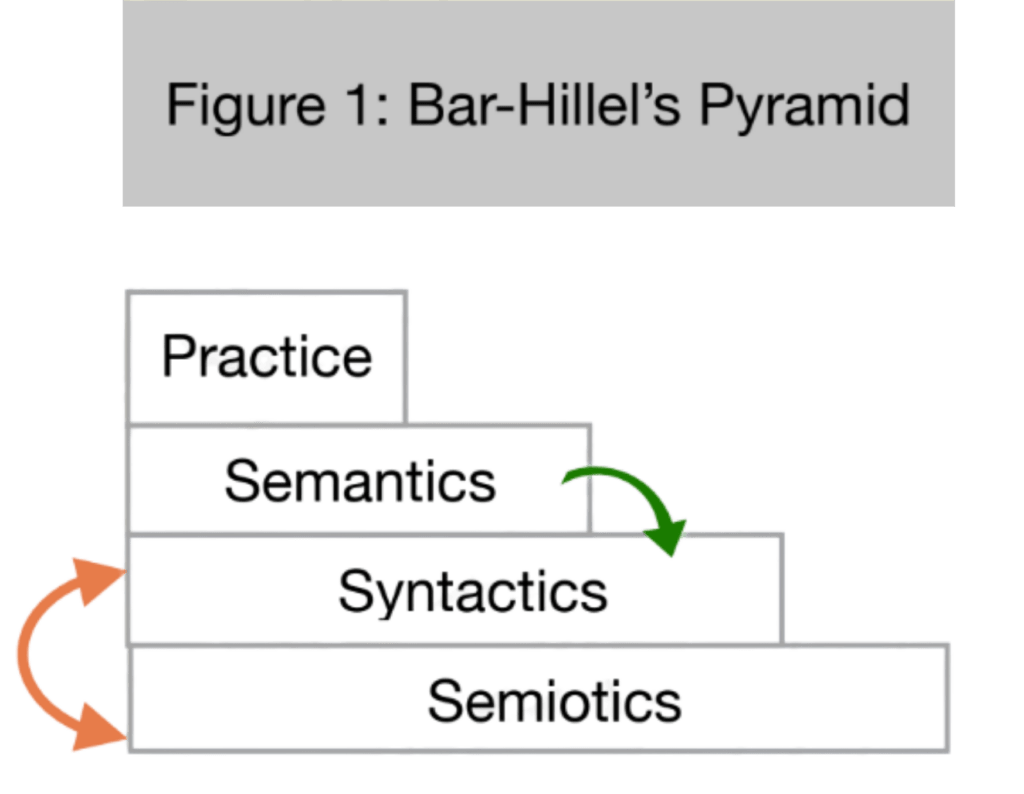
We have previously spent a lot of time to practice usefully exploiting the difference between
Semantics and Syntactics. This time we want to widen our view and explore the use of
semiotic thinking in addition to syntactic thinking. We will productively combine the two.
When we construct images, we let plastic representations of the world arise. Images have a
haptic, literally graphic grip on how we see the world. When our system recognizes something as
a representation of a possible construction of the world, it can easily adopt that construction.
Then, our experience of the world can dramatically change. We may feel stronger, things hurt less,
we see more options, we become more able to deal with dangers etc. Our inner system can
organize around these representations, evaluating the world around along them.
An inner organization around mental images can be very stable and determine our experience of
life for long times. However, in the right circumstances, inner images can become very mobile and
abruptly change in creative irrationality, beyond logic, like dreams (or in animals brains).
If we give that transgressive fluidity a helpful direction, the inner system can reorganize itself
around a new image and thus bring about advantageous perspectives of the world for us.
That is why it is very productive to familiarize oneself with the world of lucid images and learn to
put them to good use.
Letting the Dream Arise – Aspects of Wu Wei
IMAGES IN THERAPY.
Changing images to change experience is used in many approaches to therapy. Often, outer
images of a system are used to provoke change within it. Constellation work and art therapy are
prominent examples.
Less wieldy and easier to implement in small settings are inner images developed in a
conversation. We can use poetic or vivid language to strengthen the image making side in our
clients and encourage them to make graphic descriptions of the world.
GUIDED EMERGENCE OF INNER IMAGES
Working with images requires us to embrace mindful attention and non-linear, poetic thinking, and
to learn to receive and give impulses in their world.
We cannot dictate an inner image to arise and be accepted as representation of a perspective. We
can build a space in which it becomes more likely to arise, and we can give impulses, ask or suggest.
Directive thinking can and must support us in this, but it is unlikely to successfully run processes that
disrupt the linearity of our assumptions.
Suggesting to or inviting our uncontrolled sides to change images in a helpful direction is the most
poetic experience in psychotherapy.
When used to a more analytical and measuring point of view it requires much courage to entrust
yourself to a mode of experience as fluid and seemingly without firm ground. Once it becomes a
habit, it broadens the foundation on which to engage the world and adds many options to make
the world easier to live in.
It is also a very pure joy.
IMAGES AND THE STICKY WIND OF CONNECTION.
Dealing with something that arises in us and seems to have no substance but that, when its
shape transforms, takes with it how we live the world, has long been a topic in Daoism and
Buddhism.
In a Buddhist martial art for example we do not use our own strength. Instead we shape the field
between us and the opponent to redirect the flow of energy we get from the opponent to our
benefit.
This can happen as an active act, where we give an impulse that gives the system a nucleus of a
new structure to adapt to, or as an act of mindful reception, where the reception gives space for
the impulse to change its structure.
For such a structural change to happen, a particular kind of connection needs to arise between
participants, that interlocks their unconscious systems. Such a connection, a „sticky wind“, is
hard to control but experienced as joyful and haptic support. Under the label of pacing, or
„establishing of a Yes set“ much of the work in therapy is concerned with establishing such a
connection.
The inner posture needed to generate such a connection on the physical plane is very similar to
the one needed to make metaphors work to change our experience in wider settings.
WU WEI ATTITUDE AND ITS EXPRESSION IN PRACTICE
Images that pull our life perspective behind themselves, and their changes, will arise from our
creativity. We can instigate them and make it more likely that they arise, but we cannot force or
foresee them.
Working with them hence requires to work with different modes of thinking – to distinguish more
directive from more mindful thinking that lets things emerge. To apply them as needed and
combine them.
A few aspects shall be highlighted here.
Harder vs Softer Thinking and Speaking their variation.
In a „harder“ attitude, we divide the world more into objects to which we ascribe permanent
features. In such thinking, we are confronted by these objects and our action is directed against
something. In a „softer“, more mindful attitude, we live more in a world of impermanence and
collaboration, where any aspect will contain its opposite in order to really be itself.
The Yin and Yang scheme represents these contrasting approaches.
Often we define actions and attitudes in a more confrontational way without noticing it. There are
homologues to them in softer way of thinking that can be subsumed under the same name but
function completely differently.
For example, we can speak arrayed against or aligned with another person.
We can suggest something in a harder way, as an argument for why it is logical and makes sense
from our point of view. We can also view a suggestion as an impulse that reaches through the
words to connect with the inner constellation of the client to build a different perspective.
On the physical plane, in softer mode the impulse goes through the hand to prompt the inner
system of the opponent to redirect, rather than the weight of the hand pushing against the
opponent’s structure. In verbal space, the impulse goes through the words to prompt a change of
perspective, and does not produce it by the weight of the argument.
Similarly, we can ask a question to inquire about reasons and consistency, to verify and test. We
can also ask a question to increase a sense of safety and authority and possibilities of new
thinking.
Being „against“ as a condition is easy to grasp. Being „with“ is necessarily more fluid as it does
not highlight borderlines. Any attempt to describe it can at best be an approximation, understood
conditionally in a moment’s point of view.
The distinction between hard and soft appears at all levels. For example, when we listen, there are
more active and more receiving ways to build a space in which transformation can occur.
When we speak, we can open the space of thought, for example through questions or
concentrate it through direct suggestions.
Emptiness, Duality and Wu Wei
Closely related to the idea of softer thinking styles is the concept of emptiness (sunyata). In a
mode where we refrain from assigning fixed characteristics, the meaning of any part of the system
arises together with that of all other parts.
In daoist language we focus on a duality: one part needs to include its complement to be itself.
Respect for example needs a sense of direction and authority to be really respect, emergence
needs an aspect of guidance in order to emerge somewhere, fluidity needs a direction in order to
flow, mobility needs structures into which it jumps in order to be mobile.
An important duality in working with metaphors is the one between emptiness and direction. In
Chinese that is called Wu Wei, directed emptiness. The emptier our mind is, the closer we are in
contact at a non judgmental level. The more comprehensive the emptiness, the more likely
structures transform and the more effectively the transformation spontaneously finds a desired
direction.
Acceptance and trust, trust that the unconscious will guide us, that the change of the relation
changes the substance, that the client’s images work best for him, that emptiness will find a good
direction that we cannot even see yet, are fruitful challenges in working with images.
More generally, having enough variation to approach any mode in any mode and pair them in any
mode with any mode, gives us a comprehensive balance a deep center, that can act and react
appropriately in any situation.
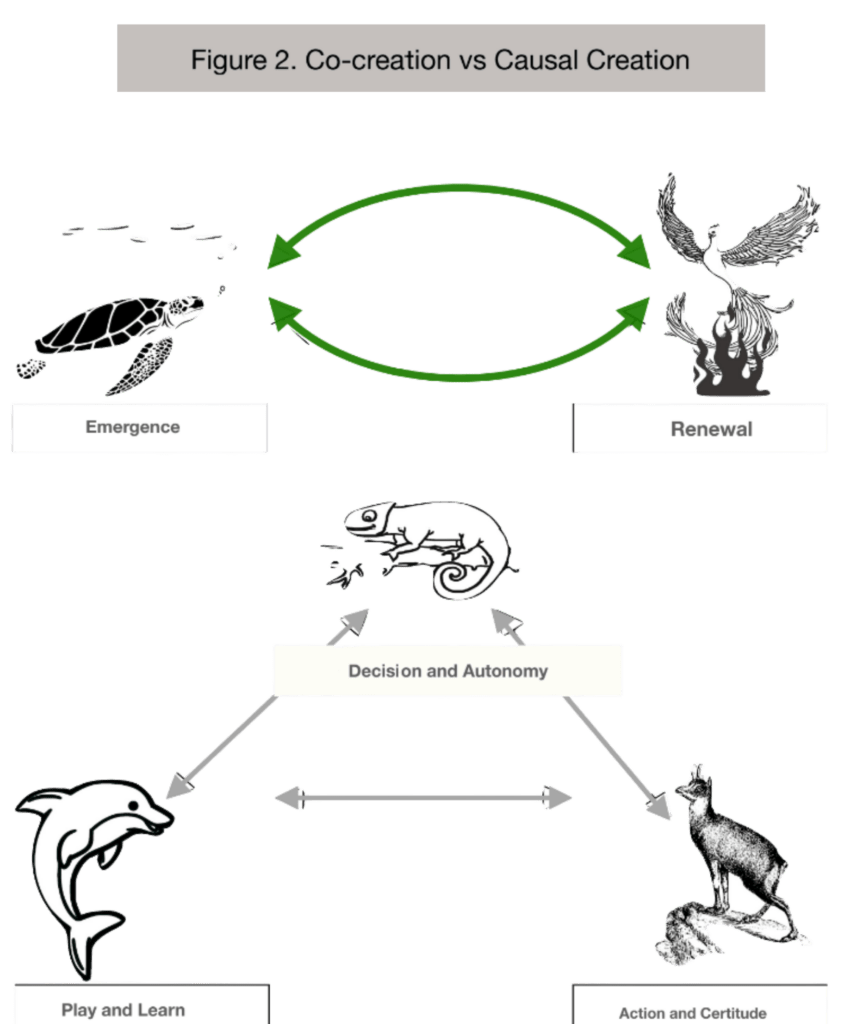
Mindful attention and non-linear renewal, represented in the 5 animals scheme by the sea turtle
and the phoenix, cogenerate each other. One cannot be without the other and generates the
other. They are two sides of the same coin.
Appreciation
An important path to further a state of softer connection, of being „with“ is appreciation.
Appreciation sounds like an obvious concept at first glance but becomes harder to grasp, the
deeper one tries to understand them.
Appreciation can be directed towards a person, symptom or a mental inner part. One way to
understand it is that it makes feel seen. Providing a sense of feeling seen can be done actively
and in accepting way.
In more active manner we visit a part or person and share their perspective.
In a more observant, softer way, we do not focus on constructing inner parts. Recognition arises
from freeing our mind from fixations thus removing obstacles for our uncontrolled parts to make
connections beyond the logic we rationally see.
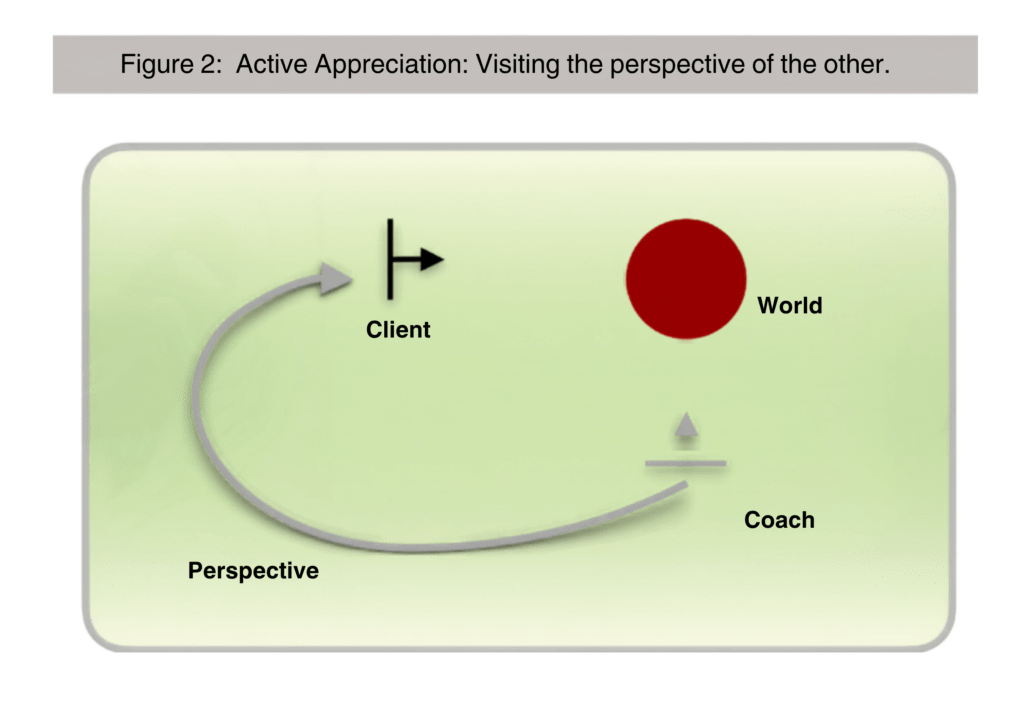
The client feels seen, when we visit his point of view without losing ourselves.
Each of these ways must contain elements of the other. Centering your mind without awareness
that there is something else outside will not guide the unconscious to appreciating it. Seeing only
the point of view of the other person will make you lose your own, leading to fixation and conflict,
not recognition.
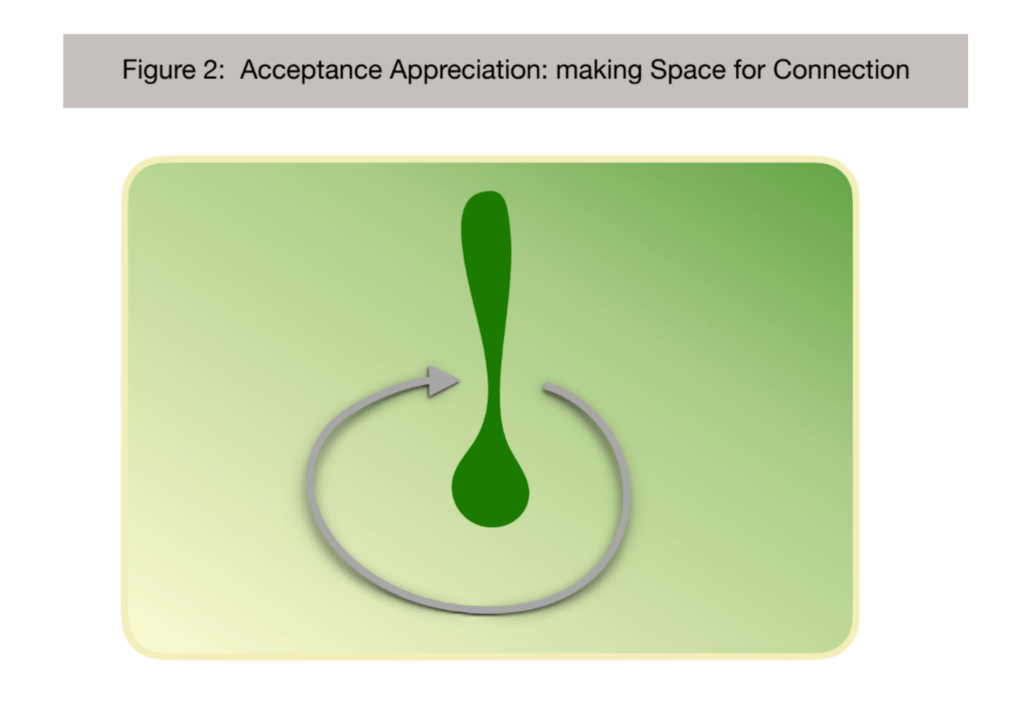
The mind drops and focuses in the deep, giving space for the other to be touched. The other is scarcely determinate.
THINKING IN IMAGES AND STRUCTURES
To encourage the transgressive power of the mind ,daoist and buddhist arts use flowery language
(the crane spreads its wings.etc).
To highlight the syntactic focus they also propose general pattens of change ( active, passive,
combining, separating etc.) which the inner system can call up to develop images. Syntactic and
Semiotic thinking are usefully combined to effect change.
Without such collaboration between the graphic and the structural, there will be no directed
change. Dreams, good music events, etc can all produce very intense and in the short term
liberating sensations and thoughts, but usually don’t effectuate permanent change.
Colourful Images
One of the great simplifying aspects of working with images is that we can work with the image as
representation of the perspective. In its simplicity it collects all the complexity of the perspective
and we and do not need to work with the perspective itself. Introducing changes to the image is
often much easier than introducing changes to the perspective.
When we develop an image, were free to use all sensory channels and all syntactic types of
thinking.
We can make up pictures in haptic, taste, smell, visual and audio senses and their combinations.
Music and voice, hapticity and temperature, color and shape, direction and movement are all fair
game to establish a good connection.
Absurdity and humor ( Phoenix), curiousity and relations to a group (Dolphin), Beauty ( Sea Turtle),
Strength, Freedom and Positioning to the outer world (Chameleon), Knowledge and Analysis
( Mountain Goat) are all variables we can change to achieve better fitting images.
Often it is helpful to look for metaphors of greater cooperation to overcome entrenched contrasts
and conflicts.